Curves and Lateral G Force
Ever since my only car was a 40-horsepower VW Beetle, I've enjoyed driving on curvy roads. Recently, while driving my current drive-for-fun car, I took a jughandle — a 270-degree freeway exit — faster than the recommended speed and noticed more lateral g force than I expected. That led me to want to put numbers to the curviness of the roads I was driving on.
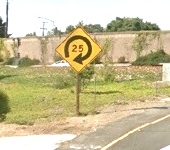 Among other things, I soon discovered that the recommended speeds posted on highway signs are not a consistent guide for drivers. Speeds posted on most highway curves tend to be conservative; speeds posted on freeway exits, not so much.
The lateral g force you feel while driving a car around a curve is the result of the centripetal acceleration ac, which depends on two things: the speed of the car and the radius of the curve. The greater the car's speed around the curve, the greater the acceleration, as you'd guess, but ac goes up faster than the speed — it goes up with the square of the speed. The formula for ac is

That means increasing your speed in a curve by only 41% effectively doubles ac and the corresponding lateral g force.
By measuring the radius of the curve using Google Maps, I was able to calculate ac for different speeds. Taking the freeway exit at the 25-mph posted speed yields ac equal to 0.29 g; at only 5 mph faster, ac inceases to 0.42 g. To give you an idea of how much that is, most cars start to go out of control at an ac of around 0.8 g.
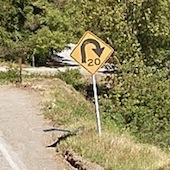
Here's an example of a conservatively-rated curve, on Stevens Canyon Road near Cupertino, California. At the 20-mph posted speed, ac is only 0.16 g. At 5 mph faster, ac is still only 0.25 g, less than the g force in the freeway exit at its posted speed.
Deriving the Equation
After using the equation for ac for a while, I ran across a web page that gave a simple derivation of it. After some thought, I came up with a derivation that is even simpler.
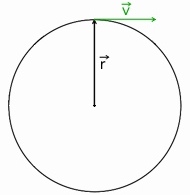
Imagine an object (in this case, just a point) moving around in a circle of radius r at a constant speed v. In the figure, the labels have little arrows above them to indicate that they are vectors. The radius vector always ends at the object, so it rotates as the object revolves. The velocity vector also rotates, staying tangent to the circle and perpendicular to the radius vector.

Time out for some formalities. The length r of the radius vector stays the same throughout, and is equal to its magnitude or absolute value, as indicated by the vertical lines in the first equation on the right; likewise for the velocity and the acceleration. You have to think of these variables as vectors in order to deal with their rotation, although the values of interest here are just their magnitudes.

As the object rotates all the way around the circle, the distance it travels, sr, is equal to 2 pi times the radius. The time it takes to do that, tr, is equal to the distance divided by the speed, v, which is just the magnitude of the velocity vector.

As the radius vector rotates once around the circle, the velocity vector also rotates through a complete circle. Here's the velocity vector in its own circle, along with its rotation speed, which corresponds to the acceleration of the object.
 One complete revolution of the velocity vector around its circle also has a distance, sv, equal to 2 pi times v, and a time, tv, equal to that distance divided by a, the rate of change of the velocity.

Because the radius and velocity vectors are locked together, the time it takes for one rotation is the same for both. Setting the expression for tr equal to that for tv yields an equation that can be solved for a in terms of r and v.
I like this derivation because it is simple — it doesn't involve any trigonometry or calculus. You may think it's too simple, perhaps even a little glib. If you browse the web, you can find many other derivations that are more formal or more rigorous.
And here's a nice thought: All those other derivations, whether formal and rigorous or quick and dirty, obtain the same result for ac. Unlike other kinds of information you can find on the web, the laws of physics are not affected by the writer's nationality, religion, political affiliation, make of car, or preferred brand of beer. I think Louis Pasteur said it best:
"Science knows no country, because knowledge belongs to humanity, and is the torch that illuminates the world."
copyright © 2016 Allen Watson III