The Land Effect, Revisited
I recently built a viewing box and tried to replicate some of Edwin Land's experiments in color perception. While I was able to confirm the basic idea — that color perception does not track with the visible-light spectrum — I was not able to replicate Land's most interesting result, which was the perception of a full-color image using only two colors.
The Viewing Box
I have often wished I could build a viewing box like the one Edwin Land used for his color-vision experiments. That recently became possible when I found a source where I could get a half-silvered mirror. I built a box with frames to hold two black-and-white transparencies lighted from behind by colored LEDs, and with the mirror arranged so that someone looking into the box would see the two images superimposed.
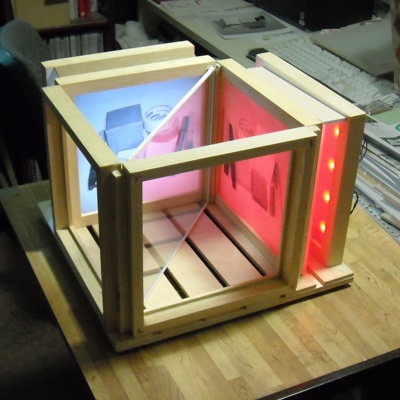
The viewing box showing the mirror, the transparencies, and the red backlight
The Colored Image and Separations
 For these experiments, I started with this image of colored objects. As you can see, it contains the full range of colors. Using Pixelmator, I applied red and green overlays to copies of the image, as shown below, then converted those images to black-and-white.
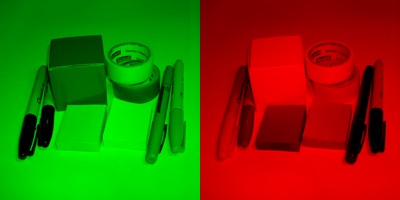
The photograph overlaid with green and red
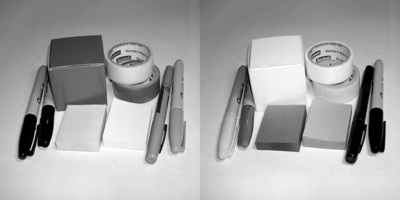
The black-and-white separations
To make transparencies for the viewing box, I printed the black-and-white images on vellum using an inkjet printer. (At first, my printer refused to print on transparent paper, but a search on the web revealed a way to get around that.)
Results: Photographs and Simulations
In Land's article, he stated that the image produced using white and red light could be reproduced in a photograph. Using a digital camera, I was able to confirm that. In fact, the photos I made captured the visual appearances better than I expected.

Photograph of the red-and-white experiment, along with the same photo with the colors balanced toward white
That being said, I was disappointed to find that none of the color combinations I used produced a full-color image when viewed. The photographs captured the appearances quite well, but even after balancing the colors toward white (again using Pixelmator), the images showed only various combinations of the source color and its complement.
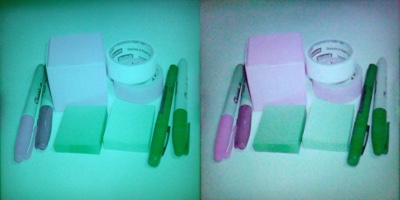
Photograph of the green-and-white experiment, before and after color-balancing toward white
The most striking complementary color appeared when I used green and white lights. The complement of green is purple, a color that does not appear in the spectrum.
To demonstrate that the limited range of colors I obtained was not due to the limitations of my experimental setup, I made some computer simulations of the experiments. The computer images are clearer, but the colors are similar.

Computer simulations of the red-and-white experiment, before and after color-balancing toward white
Conclusions and Remarks
I could not replicate Land's most dramatic experiments, the ones using very narrow-spectrum (emission) lamps. The colors from the LEDs I used, while quite intense, are not pure. Using the surface of a DVD as a reflection grating showed that, for example, the light from the green LEDs includes significant amounts of blue and yellow.
I don't think two black-and-white transparencies contain enough information to produce the full range of colors. When Land stated that the red-and-white experiment produced a full-color image, he apparently let his enthusiasm run away with his better judgement. (That would also imply that I was wrong in my earlier articles when I said I saw the Exploratorium's viewing-box images in full color. Perhaps even I am susceptible to false memories.)
At any rate, I have been able to confirm with my mirror box two interesting aspects of human color vision:
(1) the tendency to perceive neutral tones as a color complementary to the predominant color, and
(2) the tendency to normalize the overall color balance toward white.
These effects demonstrate that, as I said in an earlier article, the colors we perceive don't always correspond to specific wavelengths in the visible spectrum.
Another Example of the Land Effect
I recently got a simple demonstration of the Land effect in my bathroom, which has two light sources side by side: a normal light and a heat lamp with a red filter. A coat hook seen in the resulting strong reddish light casts overlapping shadows. With the door closed, the reddish light is the only light in the room, so the visual system normalizes the overall color toward white and makes the complementary color more apparent.

Coat hook by colored lights, as seen by the camera and as it appears to the eye
References
Where to buy a half-silvered mirror:
https://stereoscopicmirror.com/
Land's 1959 article from Scientific American:
http://www.psy.vanderbilt.edu/courses/psy236/ColorVision/Land1959.pdf
Pixelmator is sorta like Photoshop, except you don't have to subscribe:
https://www.pixelmator.com/
Two references that explain why color perception requires comparing signals from two or three types of cone cells:
https://www.ncbi.nlm.nih.gov/books/NBK11059/
https://theneurosphere.com/2015/12/07/why-are-all-the-colours-we-experience-composed-of-three-primaries/
Some examples of color constancy:
http://gurneyjourney.blogspot.com/2010/01/color-constancy.html
http://purveslab.net/downloads-2/#ccc
https://www.echalk.co.uk/amusements/OpticalIllusions/colourPerception/colourPerception.html
Everything you ever wanted to know about color and painting:
http://www.huevaluechroma.com/index.php
Copyright © Allen Watson III